
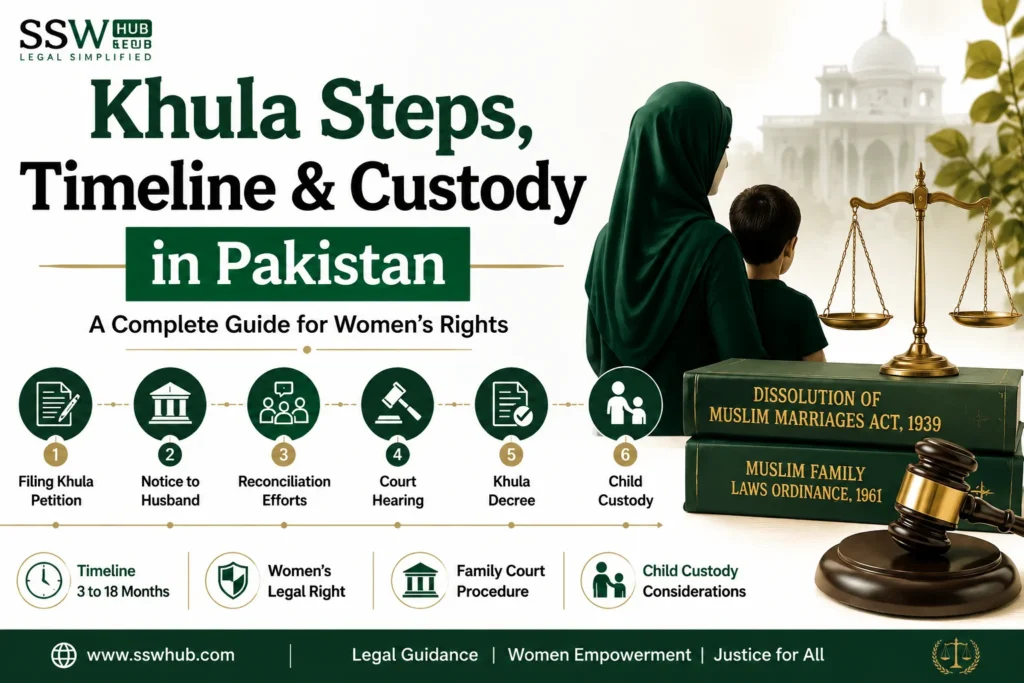
There are eight steps involved in the process of khula in Pakistan, ranging from the petition filed at Family Court to the registration of the divorce decree with NADRA. These steps fall under the provisions of the Muslim Family Laws Ordinance 1961 and the Family Courts Act 1964. The duration of the procedure depends primarily on the husband’s response.
In an uncontested case, khula can take about three months. When the husband contests it, the process can extend up to one-and-a-half years or more, because the court must hear both parties and attempt reconciliation.
Step 1: Consultation with a Vakeel (Lawyer)
Consultation is optional but strongly recommended, especially if your husband is expected to contest the case. A family law vakeel helps you file the petition correctly, choose the right grounds, and gather documents. Many organizations in Pakistan offer free or affordable consultation for women.
Step 2: Filing Your Petition in Family Court
You file the khula petition in the Family Court of the area where you or your husband currently reside. This is where the legal process formally begins. Your petition must clearly state your grounds for seeking khula.
Documents required at this step:
- Nikah nama (original or certified copy)
- Copy of CNIC (wife)
- Khula petition letter (drafted by you and your vakeel)
- Haq mehr details (from the time of nikah)
- Supporting evidence if applicable (medical reports, police reports, witness testimony)
- Birth certificates of children (if custody is sought together with khula)
Step 3: Notice Issued to Husband
Once your petition is filed, the court notifies your husband in writing and sets a court date. If he cannot be located or ignores the notice, the court proceeds regardless.
Step 4: Reconciliation Attempt
Pakistani family law requires the court to attempt reconciliation before dissolving the marriage. A judge or committee makes one or more attempts. If the wife remains firm, reconciliation cannot be forced on her.
Step 5: If Reconciliation Fails, the Case Proceeds
In most khula cases, reconciliation fails because the wife is firm in her decision. The court then moves forward with dissolution, even if the husband contests the case or fails to appear. His non-appearance does not delay the case.
Step 6: Evidence and Hearing
The wife presents her grounds, documentation, and witnesses if needed. The husband also gets the opportunity to respond. Undisputed cases may resolve in one or two sessions; contested cases can take several sessions over months.
Step 7: Court Judgment — Khula Decree Issued
Once the court is satisfied the wife cannot continue the marriage, it issues the khula decree, officially dissolving the marriage. Keep several certified copies — you’ll need them for NADRA registration and any future legal or marital procedures.
Step 8: Registering with NADRA
After receiving your decree, register with NADRA promptly to update your marital status nationally. This is also needed for passport updates, property matters, and any future marriage.
How Long Does Khula Take in Pakistan?
Faster cases (3–6 months) usually involve:
- Husband agrees and does not contest
- All documents filed correctly the first time
- Filed in a city with efficient Family Courts (Lahore, Karachi, Islamabad)
- Short reconciliation period
Slower cases (6–18 months or more) usually involve:
- Husband disputes the petition
- Husband avoids receiving notice, requiring multiple attempts
- High court backlog, common in smaller cities and rural areas
- Disputes over custody or mehr amount
- Missing or incorrect documents
The best way to avoid delays is to file complete and accurate paperwork, attend every court date, and work with a vakeel who follows up actively with the court.
Who Gets Child Custody After Khula?
Custody of young children after khula usually goes to the mother — boys until around age 7, girls until puberty — under the principle of Hizanat in Islamic law. Legal guardianship (wali), however, remains with the father.
Khula and custody are separate legal matters but can be filed together in one petition.
- Custody of young children (hizanat) usually goes to the mother under the ages above
- After that age, courts may review custody based on the child’s circumstances
- The father remains guardian (wali) for property and major life decisions
- Courts apply a “best interests of the child” standard, considering living arrangements, the mother’s remarriage status, and the child’s own preference at an older age
- Filing for custody alongside the khula petition is recommended if children are involved
Frequently Asked Questions
How many steps are involved in the khula process in Pakistan?
Eight steps, from filing the petition at Family Court to registering the decree with NADRA.
How long does khula take?
Typically 3 months to 1.5 years, depending on whether the husband contests it.
Can the husband stop khula by refusing to appear in court?
No. The process continues even if he evades court notices.
Is hiring a lawyer required for khula?
Not legally required, but strongly advised, especially in contested cases.
Who gets custody of children after khula?
Usually the mother, for boys under 7 and girls before puberty.
Can non-Muslim women apply for khula?
No. It is only applicable to Muslim women. For non-Muslim women there are different laws.