
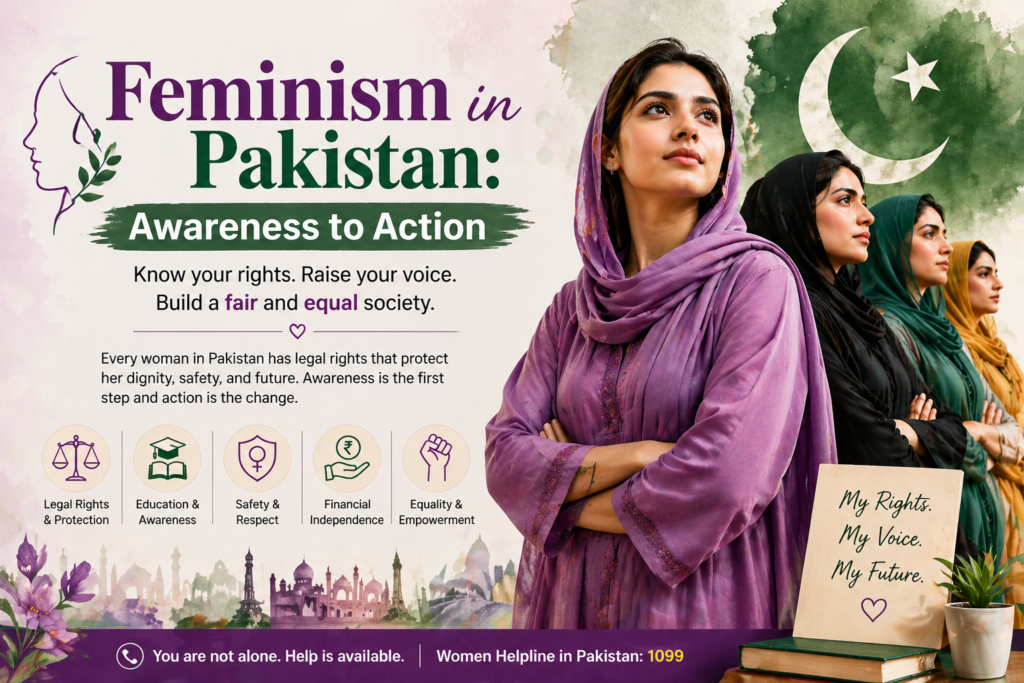
In Pakistan people are talking more About woman’s right but many women especially in villages and small towns still Do not clearly understand what these right mean. Equality and empowerment are often mentioned but they are not clearly explained in a simple and practical way.
We are not discussing something complex or lawyer-only when we discuss women legal rights in Pakistan. We are discussing fundamental safeguards that every woman must know in her day to day life- at home, in school, in marriage, and in the society.
This blog is aimed at explaining legal rights of women in Pakistan in a very simple manner so that anyone can know what is fair, what is allowed and how to seek help when necessary.
What Are the Legal Rights of Women in simple words ?
The question that many people pose is a simple one:
What are the legal rights of women?
These are in simple terms, the safeguards provided by law that guarantee women are treated with dignity, safety and fairness. Human rights of women in Pakistan include these rights, which means that they are not privileges, but fundamental rights.
The fundamental legal rights that every woman ought to be aware of are:
– The right to a peaceful and non-violent existence.
– The right to education and self-development.
– The freedom to choose concerning marriage and life.
– The right to just treatment in family affairs.
– Property and inheritance rights.
– The right to labor and to earn.
– The right to demand justice in case of something wrong.
The initial step to protection and independence is to understand these rights.
Legal Protection and Safety for the Women
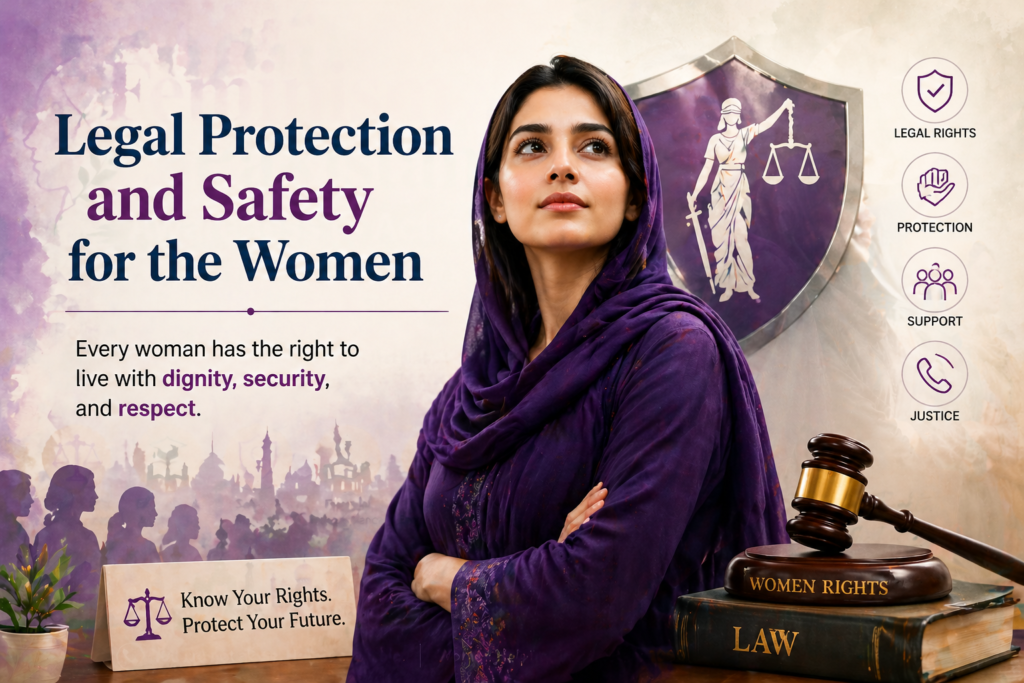
Pakistan has enacted some laws on women protection that seek to offer legal protection to women in various circumstances. These lawful acts are meant to safeguard women against abuse, harassment, and unfair treatment.
When a woman is exposed to domestic violence, be it physical, emotional, or psychological, she is eligible to seek help . It is not a personal or a private problem but a legal one.
But the law is not the only challenge, but awareness. A lot of women lack complete knowledge of legal rights awareness of women and that is why they keep quiet even when they are in need of assistance.
This is why understanding women’s right is important so women know when and how to take action
Access to Justice: The way women can defend their legal rights.
Knowing rights is important, but knowing how women can protect their legal rights is even more important.
Women in Pakistan may seek assistance by:
– Local police stations (to report abuse or threats)
– Family courts (for divorce, custody, and maintenance cases)
– Women protection centers
– Legal aid services (free or low-cost legal assistance)
There is also support in most regions by a latest helpline of woman rights in Pakistan where women may seek immediate advice in case of violence or emergency. These services are available to offer fast assistance, yet not all women know about them.
The greatest problem is not absence of systems, but absence of information.
When Silence Becomes a Barrier.
Women are conditioned to remain quiet and adapt even in unfair circumstances in most families. But silence tends to compound things.
Domestic violence and honor-based violence are not cultural values, but rather violation of fundamental dignity and law. No woman must be made to endure abuse.
The actual change starts when the society realizes that it is not embarrassing to speak up, it is a must.
The Importance of Legal Rights to Women.
The question of why women should have legal rights remains a question to many.
The reason is easy to guess: they safeguard life, dignity, and future security. Women are not aware of their rights and can be easily pressured, controlled, and unfairly decided.
Women are confident in legal rights. They assist them to make wise decisions and guard themselves in challenging circumstances.
Learning and Awareness work together
Women have a good role in education in terms of legal rights awareness. Financial pressure, early marriage, or social pressure cause many girls to drop out of school.
Girls will be more likely to know their rights and raise their voices when something is wrong when they are educated. A single educated female in a family can make a long-term change.
Digital learning has also provided women with new opportunities to learn at home today, which contributes to developing independence.
Financial Independence and Strength
Women are more independent and confident when they earn. Financial independence does not mean competition, it means security and freedom.
Freelancing, teaching, stitching, cooking and online businesses have become some of the ways through which many women in Pakistan work at home. Financial awareness, in addition to earning, is also significant to long-term stability.
Boundaries and Emotional Well-being.
Women tend to bear the burden of emotions in silence because of expectations, relationships, or social judgment.
But mental well-being is just as important as physical safety. Peace, respect and emotional security are the rights of every woman.
Boundaries or quitting toxic situations is not a sign of weakness, but it is a sign of strength.
Religion, Culture, and Misunderstanding.
Cultural traditions are sometimes mixed up with religion. This brings confusion regarding the rights of women.
As a matter of fact, Islam provides women with explicit rights such as education, inheritance, respect and consent in marriage. These rights are however restricted or misunderstood by some cultural practices.
This difference is significant to know in order to be truly aware.
The Pressure Of Marriage in Society
Marriage is regarded as a significant milestone in life, yet the pressure surrounding it may result in forced or early marriages.
The mentality of log kya kahenge usually compels women to remain quiet even when they are not at ease.
Marriage must be founded on choice, consent, and respect. The status of a woman is not determined by whether she is married or not.
Social Media: Awareness and Challenges:
social media has become a powerful tool for awareness and opportunity. It assists women to learn, earn and speak out.
Simultaneously, it also puts pressure by unrealistic expectations and subjects women to online harassment.
Wise use implies reaping the benefits and safeguarding mental health.
A Real-Life Reflection : A Real story
Women are still advised to abandon their inheritance or remain silent in many families in the name of peace. However, this can be very costly in the long term, resulting in financial dependence and insecurity.
Such cases are quite frequent, yet not always talked about openly.
It is not sufficient to be aware. Actual change occurs when individuals understand how to take action on it.
Women require straightforward instructions, support networks, and assurance to exercise their rights. Families and communities should establish safe spaces rather than judgmental spaces.
Even minor actions in consciousness can bring about social change in the long run.
Conclusion
Women legal rights in Pakistan is not merely a matter of law or policy, but it is a matter of life. It is not just the fact that there are women protection laws, but the ignorance and unawareness of people. Women become confident, strong and independent when they are aware of their rights.
And as women become stronger, society becomes stronger. This is not merely a matter of rights. It is dignity, awareness and actual change.
Your Rights Are Real — And So Is Your Voice.
At SSWHub, we believe every woman deserves access to clear information, honest guidance, and a supportive community. Whether you are seeking to understand your legal rights, grow financially, or simply find a safe space to learn — you are in the right place.
Explore more resources on SSWHub 👉 Visit and take your next step forward — because awareness is where change begins.