
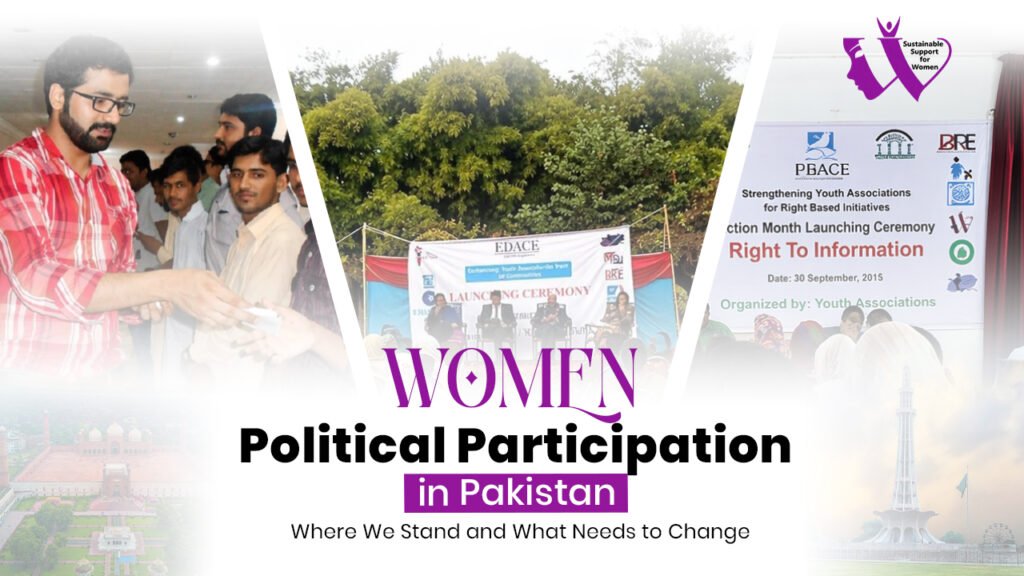
Pakistan has over 220 million people. Roughly half are women. Yet when you look at the National Assembly, the Senate, or any provincial assembly, women are a clear minority.
Women’s political participation in Pakistan is not a new debate. But it is an urgent one. Fresh data from 2024–2025 reveals a sharp contradiction: female parliamentarians are outworking their male peers by almost every measure, yet they hold only 17% of seats and face growing institutional resistance.
This article examines where women stand, what the real impediments to women’s political participation in Pakistan are, and what it actually takes to change this.
Where Women Stand in Pakistani Politics Today
The Constitution of Pakistan reserves 60 seats for women in the National Assembly, 17 in the Senate, and 168 in provincial assemblies. On paper, that looks like inclusion.
The numbers say otherwise.
As of 2024–2025, women hold just 17% of parliament — 69 out of 399 members — far below the UN’s recommended minimum of 33%. Pakistan ranks 100th out of 190 countries in women’s parliamentary representation per the Inter-Parliamentary Union, and last among 148 countries in the Global Gender Gap Index 2025 on political empowerment.
There is also a voter gap. Pakistan has 59 million registered female voters, yet only 42% voted in the last general election — a 5% fall from 2018. Political participation in Pakistan, at its most basic level, is still being denied to millions of women.
The Reserved Seats Problem
Reserved seats were designed as a temporary bridge. They have become a permanent ceiling.
Most women in parliament did not win a general constituency seat. They entered through party lists under the quota system, which means they are accountable to their party — not to voters. A woman with no direct electoral mandate has a structurally weaker voice in the house, regardless of her ability.
The end goal must be women winning open, contested general seats — not filling quota slots allocated by party bosses.
2025 Data: Women Work More, Get Credited Less
The 2024–2025 parliamentary data makes the double standard impossible to ignore.
Women make up 17% of parliament but contributed 49% of the total parliamentary agenda — the highest share since 2015. Female MNAs initiated 55% of all legislative business in the National Assembly. Each female MNA submitted an average of 17 agenda items, more than five times the male average of three. Women attended 75% of sittings compared to 63% for male MNAs.
Despite this, the National Assembly addressed only 67% of women-sponsored agenda items in 2024–2025, down from 81% in 2021–2022.
Women are doing more and being heard less. That is not a gender gap. That is a structural problem.
Impediments to Women's Political Participation in Pakistan
These are not personal failures. They are barriers built into the system over generations.
Patriarchal family structures: sit at the root. In many households, a male family member decides whether a woman registers to vote, which party she supports, and whether she can run for office. Political agency is blocked before it begins.
Social norms and honor culture: frame politics as a masculine, public-facing space that puts a family’s reputation at risk. This pressure is strongest in rural areas of KPK, Balochistan, and interior Sindh — where women participation in politics in Pakistan faces the most direct resistance.
Party gatekeeping: is the most direct structural barrier. Across 138 political parties, only 7% of party office-bearers elected between 2018 and 2025 were women, per FAFEN data. Women are routinely assigned unwinnable constituencies — kept visible but kept powerless.
Financial barriers: are real. Election campaigns in Pakistan are expensive. Women have less access to personal wealth and fewer donors willing to back them, which effectively bars many qualified women before a vote is cast.
Threats and harassment: function as a deterrent. Female candidates — especially in KPK, Balochistan, and rural Sindh — face character attacks, intimidation, and in some cases physical threats. Fear of violence stops many women from entering the race at all.
Low voter registration: remains a structural exclusion. Millions of women in certain districts have never been registered, often without having had a say in the matter. You cannot participate in politics you are excluded from on paper.
How Women Can Participate in Politics in Pakistan
Understanding the barriers is necessary. So is knowing the entry points.
Start with voter registration. The most fundamental act of political participation is voting. Women who are unregistered can visit any NADRA office or use the Election Commission of Pakistan’s online portal. Helping female family members and neighbors register is itself a form of political activism.
Enter through local government. Union councils and tehsil councils are the most accessible starting point for women participation in politics in Pakistan. The scale is smaller, costs are lower, and reserved seats create genuine openings. A significant number of Pakistan’s senior female politicians began at this level.
Join party women’s wings. Every major party has one. Building networks and advocating from within a party’s structure directly increases the chance of being offered a competitive seat — which is where real power lies.
Build political awareness. Political awareness for women in Pakistan begins with knowing the basics: the right to vote, the right to register, the right to stand for election. Awareness work — through school groups, community meetings, or social media — shifts the conversation at the neighborhood level, which is where culture actually changes.
Benazir Bhutto: Historic but Not Sufficient
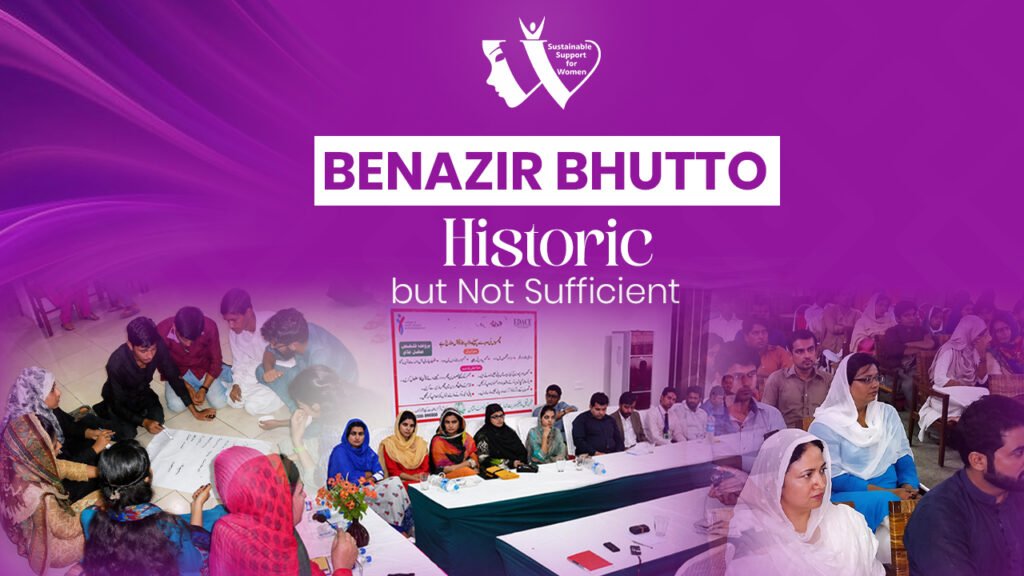
Benazir Bhutto was the first woman to lead a Muslim-majority country as Prime Minister, serving two terms. That milestone is real and significant.
But one historic figure does not represent the whole picture. She was appointed Prime Minister after her party won elections — not directly elected to the office. Her assassination in December 2007 removed one of the most prominent voices for democratic participation in the country. And her example at the top has not translated into structural inclusion at the base.
A democracy cannot rely on exceptional individuals to prove it is working.
What Genuine Change Requires
Parties must offer women winnable seats. When 7% of party leadership is female, unwinnable tickets are the predictable outcome. This has to change at the party nomination stage.
Campaign finance must address the gender gap. Access to funds — whether through public financing or mandatory party support — is a precondition for competitive candidacy.
Reserved seats must evolve. The current system gives parties control over who fills quota seats. A stronger model would require direct election even within reserved seat arrangements, making women accountable to constituents rather than to party lists.
Girls’ education is the long-term lever. Educated women register, vote, run for office, and hold representatives accountable at significantly higher rates. Every year of girls’ schooling lost is a generation of political participation delayed.
Cultural change must accompany legal change. Legislation opens the door. Families, communities, elders, and religious leaders have to be part of the conversation about why women belong in public life. That conversation happens at the local level — not in Islamabad.
At SSW Hub, we document these barriers and the women breaking through them. Follow our platform to stay informed and connected.