
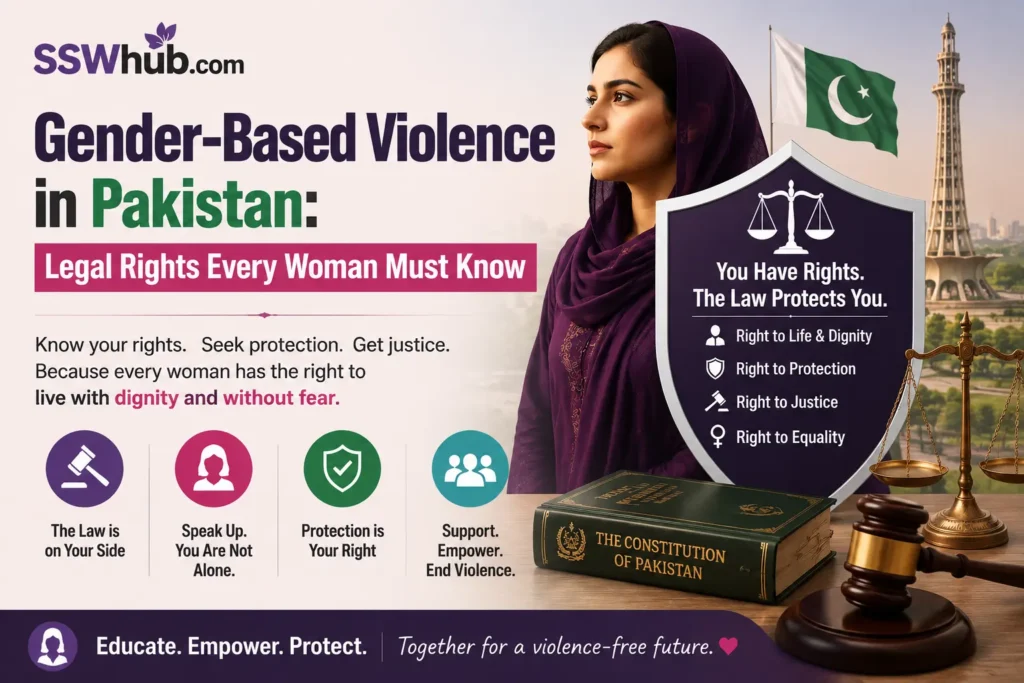
Every single day, women in Pakistan face gender-based violence — issues that render them helpless, humiliated and voiceless. There is the wife who stays silent through years of domestic violence because she believes no one will listen. There is the young woman who quietly leaves her job after months of workplace harassment, unaware she has a legal right to fight back. There is the girl married off before she was ready, not knowing the law was always on her side.
These are not isolated stories. They are the lived reality of countless women across Pakistan. What they all share is this: the violence they face is rooted in their gender. Knowing what gender-based violence is, understanding its many forms, and being aware of your legal rights in Pakistan can mean the difference between silence and justice — between agony and hope.
What Is Gender-Based Violence? (Definition & Types)
Gender-based violence (GBV) is any act of violence directed at a person because of their sex, gender, or gender identity. It is a direct product of unequal power relations and is carried out with the intent to humiliate or strip away a person’s dignity. [Council of Europe ↗]
GBV is a grave violation of human rights. While it can affect anyone, women and girls face disproportionate risk — globally, one in three women will experience physical or sexual violence in her lifetime. [UNHCR ↗]
📖 Related: Women’s Legal Rights in Pakistan — A Complete Guide
Domestic Violence
The most prevalent and reported form of GBV. It includes physical assault, psychological abuse, economic control, and sexual violence within a household — most often by a husband, family member, or partner. In 2024, over 2,200 domestic violence cases were officially registered across Pakistan. [SSDO ↗] Provincial Domestic Violence Acts exist in Punjab, Sindh, and KPK, though enforcement remains a challenge.
Workplace Harassment
A deeply underreported form of GBV. It encompasses verbal abuse, sexual advances, hostile working environments, and intimidation tied to job security. Around 93% of working women in Pakistan report experiencing some form of workplace harassment. [Oxford Human Rights Hub ↗] Pakistan’s Protection Against Harassment of Women at the Workplace Act 2010 criminalises this behaviour and gives women the right to file a formal complaint.
Cyber Harassment
A fast-growing threat in the digital age. This includes sharing private images without consent, cyberstalking, online threats, and identity misuse on platforms like Facebook and WhatsApp. Between 2020 and 2024, the FIA’s Cybercrime Wing received over 639,000 complaints, a significant portion involving women. [FIA ↗] The Prevention of Electronic Crimes Act (PECA) 2016 is the governing law.
Forced Marriage
A persistent practice especially in rural communities. Pakistan ranks sixth globally for the highest number of child brides, with an estimated 19 million girls married before the age of 18. [UNICEF ↗] Every woman in Pakistan has the fundamental right to enter marriage freely and with full, informed consent.
Stalking & Psychological Abuse
Often dismissed, but deeply harmful. Persistent following, surveillance, emotional manipulation, and intimidation all constitute gender-based violence and carry serious legal consequences.
Financial / Economic Abuse
Any controlling behaviour that keeps a woman financially dependent on an abusive partner — restricting access to money, preventing employment, or controlling household finances — is a recognised form of GBV.
How Serious Is Gender-Based Violence in Pakistan?
32,617+
GBV cases officially reported in Pakistan in 2024 — with a national conviction rate of just 0.5% for rape and 1.3% for domestic violence. [SSDO Mapping GBV 2024 ↗]
The Human Rights Commission of Pakistan (HRCP) recorded over 60,000 cases of violence against women and children in Punjab alone in 2024, with only 924 convictions. These numbers represent only what was reported — the real scale is far greater due to underreporting driven by stigma, fear, and lack of awareness.
When women live under the threat of violence, entire communities suffer. Children raised in violent environments often carry that cycle forward. Societies that fail to protect their women ultimately pay that cost many times over.
Women’s rights are human rights. Under both Pakistani law and international frameworks — including the Convention on the Elimination of All Forms of Discrimination Against Women (CEDAW), to which Pakistan is a signatory — every woman’s right to safety, dignity, and a life free from violence is legally enshrined.
What Legal Rights Do Women Have Against Gender-Based Violence in Pakistan?
Pakistan has a legal framework protecting women from GBV. Knowing these laws is one of the most powerful tools available to any woman.
| Law / Act | What It Covers | How to Use It |
|---|---|---|
|
Protection Against Harassment of Women at the Workplace Act 2010 (amended 2022 |
Workplace harassment — verbal, physical, sexual, intimidation |
Every employer must form an Inquiry Committee. File complaint with employer or the Ombudsperson. |
|
Prevention of Electronic Crimes Act (PECA) 2016 |
Cyberstalking, online threats, non-consensual image sharing |
Report to NCCIA at complaint.nccia.gov.pk or call helpline 1799. Penalty: up to 3 years imprisonment. |
|
Domestic Violence Acts — Punjab, Sindh, KPK |
Domestic abuse, emotional and financial abuse within households |
Apply for a Protection Order — a court order barring the abuser from approaching or contacting you. Breach of Order carries penalties. |
|
Muslim Family Laws Ordinance 1961 |
Rights on marriage, divorce, and inheritance |
Know and assert your rights — many are hidden or misrepresented. SSW Hub can help clarify. |
|
FIR at any Police Station |
All forms of gender-based violence |
Any woman can file an FIR. If a police officer refuses, report them to the Senior Superintendent of Police or higher authorities. |
What to Do If You Face Gender-Based Violence in Pakistan
Whether you’re experiencing any form of gender-based violence, you are not alone and you do not have to suffer in silence. Here is what you can do right now:
1: Protect yourself first
If you are in immediate danger, remove yourself from the situation if it is safe to do so, and call the police (15).
2: Document everything
Keep a record of what happened — note dates, save text messages, screenshot social media threats or harassment. Written records matter in court.
3: Know your legal rights
Understanding which laws apply to your situation is one of the most powerful protections available to you.
4: Speak to someone you trust
A family member, friend, or local authority may be able to help you or connect you with support.
Conclusion
Gender-based violence in Pakistan is a reality too many women live with every day. But it does not have to stay that way. Women in Pakistan have legal rights, legal protections, and organisations standing beside them — they simply need to know these tools exist.
No matter what form of violence you are facing — domestic abuse, workplace harassment, cyber bullying, or anything else — support is available. SSW Hub can help you understand your options and determine what steps are right for you. You are entitled to a life free from violence and fear.
Frequently Asked Questions
What is gender-based violence (GBV)?
Gender-based violence is any form of violence — physical, sexual, psychological, or economic — directed at a person because of their gender. It is rooted in unequal power relations and is a recognised violation of human rights.
How common is gender-based violence in Pakistan?
Over 32,617 GBV cases were officially registered in Pakistan in 2024 — including rape, domestic violence, honour killings, and abductions. The actual number is significantly higher due to underreporting.
What are the different types of gender-based violence?
These include domestic violence, workplace harassment, cyber harassment, forced marriage, stalking, psychological abuse, and financial/economic abuse.
What should a woman do if she faces gender-based violence in Pakistan?
Ensure your safety first, document the incident, file an FIR at the nearest police station, apply for a Protection Order if needed, and contact a women’s support organisation like SSW Hub.
What legal protections exist for women facing domestic violence in Pakistan?
Women can seek a Protection Order under the Domestic Violence Acts in Punjab, Sindh, and KPK. They can also file an FIR and access legal aid through the courts.
What is the law on cyber harassment in Pakistan?
PECA 2016 criminalises cyberstalking, online threats, and the non-consensual sharing of images. Women can report to the NCCIA at complaint.nccia.gov.pk ↗ or call helpline 1799.