
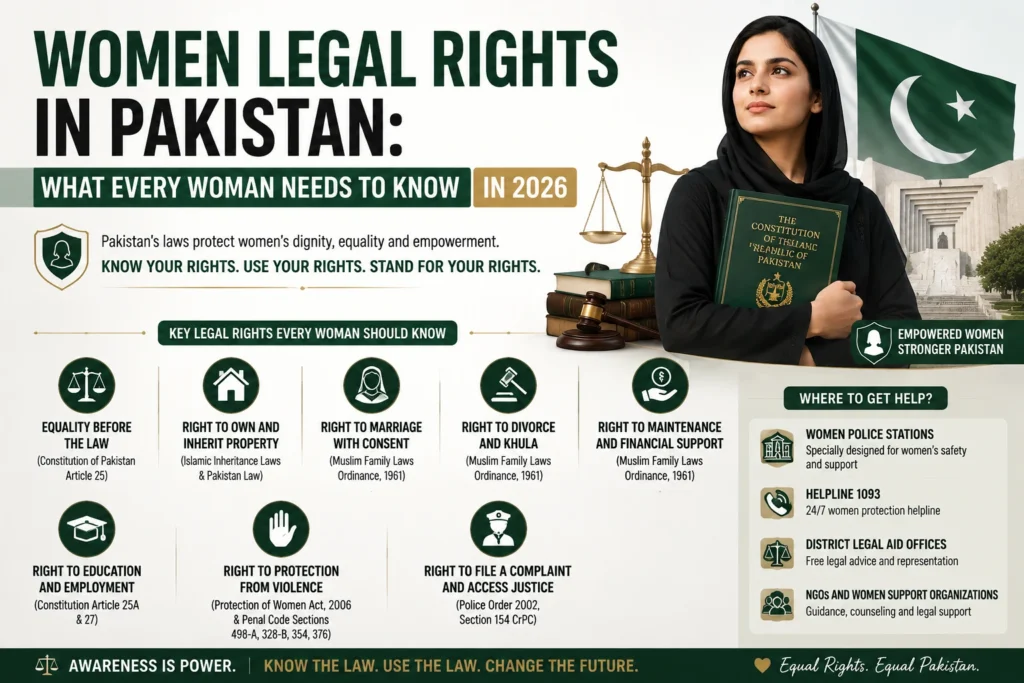
Women legal rights Pakistan are guaranteed under Article 25 and Article 34 of the Constitution of Pakistan. Every woman regardless of her location, education, or background — has the legal right to inheritance, protection from violence, divorce,
and equal treatment before the law.
Imagine a woman whose brothers have taken her inheritance. She knows something is wrong — but she does not know the law is on her side. Imagine another woman enduring violence at home, unaware that Pakistan’s courts can issue a protection order within hours. Or a young girl who signed her Nikah Nama without reading it, not knowing she could have written her own rights into that contract.
These are not rare stories. They happen every day across Pakistan. And in almost every case, the law already protects these women — they just do not know it.
This guide explains women legal rights in Pakistan in plain language — what the law says, why so many women still cannot access it, and what you can do if your rights are being violated.
1. What Does Pakistani Law Actually Guarantee Women?
Two articles in Pakistan’s Constitution form the foundation of women’s legal rights:
Article 25 — Constitution of Pakistan, 1973
All citizens are equal before the law. No person can be discriminated against on the basis of sex.
Article 34 — Constitution of Pakistan, 1973
The state is legally obligated to ensure women’s full participation in all aspects of national life. This is not a suggestion — it is a binding duty.
Beyond the Constitution, several specific laws protect women across different areas of life.
Key Women Legal Rights Pakistan Every Woman Must Know
Right to Inheritance and Property
Under Islamic inheritance law and Pakistan’s civil code, a daughter, wife, mother, and sister all have a legally defined share of a deceased family member’s estate. Denying a woman her inheritance is not a family matter — it is a violation of law. A woman can file a claim in civil court at any time.
Protection from Domestic Violence and Harassment
The Punjab Protection of Women Against Violence Act 2016 allows a woman to apply for an immediate protection order, a residence order, and financial relief from the court. Similar protections exist in Sindh and Khyber Pakhtunkhwa. A woman does not need a lawyer to file an initial complaint.
Right to Divorce and Nikah Nama Protections
Before signing a Nikah Nama, a woman can negotiate conditions — including the right to initiate divorce (delegated divorce). If the marriage breaks down, a woman can seek Khula through family court even if her husband refuses. The court can grant Khula after a reconciliation attempt fails.
Right to a Fair Trial
No woman can be arrested or detained except in accordance with law. Every woman accused of a crime has the right to legal representation, a speedy trial, and treatment with dignity throughout the legal process.
Why Women Legal Rights Pakistan Are Still Out of Reach?
The gap between what the law says and what women actually experience is wide. Research on women legal rights in Pakistan consistently identifies the same barriers:
- Lack of awareness — Most women are never taught their legal rights at home, in school, or in their communities.
- Family pressure — Legal disputes within families are treated as private matters. Women who approach courts are often seen as disloyal.
- Financial dependence — Without independent income, hiring a lawyer feels impossible.
- Social stigma — Women who speak up about abuse, inheritance denial, or divorce face isolation and judgment.
- Complex legal procedures — Court processes, filing requirements, and legal terminology are genuinely difficult to navigate without guidance.
- Geographic distance — Women in rural areas often cannot reach courts, legal aid offices, or women’s protection bureaus.
Knowing these barriers exist is the first step. The second step is knowing they can be overcome — with the right support.
What Should You Do If Your Rights Are Being Violated?
If you believe your legal rights are being violated, here is a clear, step-by-step path:
- Identify the right — Know which law applies to your situation (inheritance, domestic violence, divorce, property).
- Collect evidence — Save messages, photographs, medical records, or any documents relevant to your case.
- Reach out to a legal resource — This can be a lawyer, a legal aid office, or a firm like SSW.
- Go to the right authority — Family court for divorce and custody. Civil court for inheritance. Police or Women Protection Bureau for violence.
- Do not go alone — Organizations like SSW provide free guidance so you understand every step before you take it.
How SSW Supports Women Legal Rights in Pakistan
Sustainable Support for Women (SSW) is a firm working across Pakistan to ensure every woman — regardless of education, location, or background — knows and can access her legal rights.
SSW provides free legal awareness, counseling, and step-by-step guidance in plain language. No woman has to face the legal system alone.
Frequently Asked Questions
What are the legal rights of women in Pakistan under the Constitution?
Article 25 guarantees equality before the law regardless of sex. Article 34 requires the state to ensure women’s participation in all areas of public life. Together, these form the constitutional foundation of women’s legal rights in Pakistan.
Can a woman claim her inheritance if her brothers refuse to give it?
Yes. A woman’s right to inheritance is protected by law in Pakistan. She can file a claim in civil court. SSW can help her understand the process and connect her with legal support.
Can a woman get a divorce without her husband’s agreement?
Yes. A woman can apply for Khula through family court. The court will attempt reconciliation first. If reconciliation fails, the court can grant the divorce even if the husband does not agree.
What should a woman do if she is experiencing domestic violence?
She can approach the police or a Women Protection Bureau in her province. Under the Punjab Protection of Women Against Violence Act 2016, courts can issue an immediate protection order. SSW offers confidential support to help women take this step safely
Is free legal help available for women in Pakistan?
Yes. SSW provides free legal awareness, guidance, and referrals to women across Pakistan — online and through field teams. Other legal aid organizations also operate in major cities.
What rights can a woman add to her Nikah Nama?
Before signing, a woman can negotiate conditions including the right to work, the right to initiate divorce, restrictions on polygamy, and custody arrangements. These become legally binding once signed.