

Women inheritance rights Pakistan are protected under the Muslim Family Laws Ordinance 1961, Muslim Personal Law (Shariat) Application Act 1962, and the Enforcement of Women Property Rights Act 2020. Every daughter, wife, mother, and sister has a legally defined share in inherited property that cannot be denied by family or custom.
Think about it, Say the woman was 77 and had been the pillar of her family, who had devoted her life to her family. Her father died, she demanded her share in the property and her brothers told her she had no share in the property. The woman was unaware of her legal rights, while her brothers knew exactly what the law provided.
It’s an issue that appears far too frequently in Pakistan. Inheritance rights for women in Pakistan are enshrined in our laws; yet millions of women are denied their legal entitlements. Be it communal pressures, lack of knowledge, or conflict in the family, women are often marginalized in inheritance issues. Here’s an ‘explain-all’ on what the law states, what rights women in Pakistan have and how to claim them.
Understanding Women Inheritance Rights Pakistan
Women in Pakistan can claim the right of inheritance through both Islam traditional laws and the civil laws of property inheritance. For every Woman , Daughter, Wife, Mother, and Sister, there is a settled, inalienable share in a departed person’s property.
The above fact is backed by various Other laws like on the Indian front- Muslim Family Laws Ordinance 1961 and for West Pakistan , Muslim Personal Law (Shariat) Application Act 1962. The fact thus stands that no leave for the women to get her rightful share.
Inheritance provides women with security and independence. Having their due share in law allows women to save for their families as well as and invest for their children’s education and their dignity. Women’s financial rights are more than their rights.
What are the legal provisions for daughters’ inheritance?
The relevant laws are discussed below:
(a) Constitution of Pakistan.
(b) Muslim Personal Law ( Shariat) Application Act 1962.
(c) Muslim Family Laws Ordinance, 1961.
(d) Succession Act 1925
(e) Enforcement of Women property Rights Act 2020.
Islamic Perspective on Women Inheritance Rights Pakistan
The Constitution of Pakistan, in Para 27 of Pakistan’s Islamic Ideology Resolution or the dictum of the nation of Pakistan, affirms the Islamic law of inheritance including inheritance of and by daughters. In Para 32, Pakistan’s Islamic Ideology Resolution states the balance of inheritance as enshrined in the Holy Quran. Dozens of provisions of all the above laws provide details of distribution of property inherited by daughters.
Under Pakistani inheritance law, a daughter receives half of what is given to a son. If there are no male relatives then sometimes the daughter inherits all (or nearly all) of the estate.
The law on daughters inheritance in Pakistan is quite straightforward: Any family member cannot cut a daughter out of a will. Unfortunately, many families wrongly believe that when a daughter is married she does not inherit. This is untrue. A daughter’s marital status does not affect her claim to a Share, in property or not.
Penalties for Depriving women of inheritance Pakistan
Rights over property by women are not only limited to inheritance. A woman has absolute legal right to buy, sell, transfer and own property in her own name. Land ownership by women is also guaranteed by law in Pakistan.
Post marriage, the wife’s rights to her individual property rights continued to be intact. Mehr, gifts & inheritance property continued to be her individual property & no her husband has direct right thereon. Also,Women have legal rights in property of being a lessee, a borrower of loans.
However, still many women are unaware of them. Women’s legal awareness programs are a step towards such claims.
Why Are Women Often Denied Their Inheritance?
Though women are provided for by law, they are still commonly deprived of inheritance in Pakistan. Main factors are;
Women are told that it is their duty to relinquish their rights voluntarily ‘for the greater good’ and that this is an act of loyalty or respect for their families. In the rural districts of Pakistan, traditional practices take precedence over the law with family rights and property decisions being made by tribal councils or mandates where there is no legal status.
The knowledge of women in Pakistan regarding legal issues is also very low and when they are aware then they don’t stand for their rights due to financial dependence of women on male members of their family but the property disputes are very expensive and tragic and lengthy it leads women to compromise.
Understanding women inheritance rights Pakistan is the first step toward claiming what the law has already guaranteed.
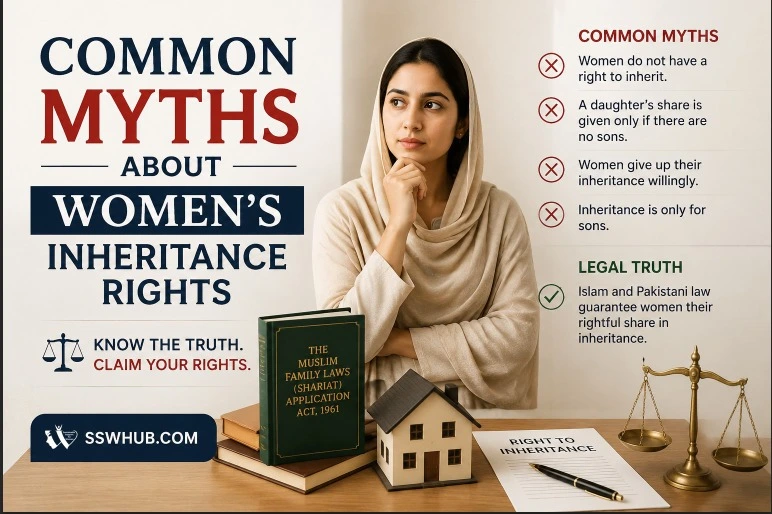
Common myths about women’s Inheritance Rights
Benami property is property registered in the name of one person and owned by or paid for by another. This practice has been employed traditionally to deny women ownership-for example, registering land in the name of a son so that daughters do not receive property.
Many myths surrounding women inheritance rights Pakistan prevent women from ever approaching a court or lawyer for help.
The Benami Transactions(Prohibition) Act 2017 has now made them illegal. Women now have the legal recourse to challenge the wrongdoers in a court of law and seek redress for the wrongful transaction that failed to give them their due. Consult a lawyer if you suspect benami transactions in your home.
The majority of family assets in Pakistan is agricultural land, in Punjab and Southern Punjab specifically. Land rights for women in Punjab are protected by law but in practice rural women encounter many obstacles.
In most villages,many see the inheritance of land by women as not culturally acceptable. Sometimes it is resolved by jirgas or panchayats and not by courts. Inheritance law of Southern Punjab Pakistan is gender neutral and binding but is weakly implemented.
The Punjab Land Records Authority provides women internet access to confirm land ownership and assert land rights. However, rural awareness campaigns will be needed to bring this information to the ground.
How Can Women Claim Their Inheritance in Pakistan?
To exercise women inheritance rights Pakistan, the process begins with gathering the right legal documents.
Gather your foundational documents at the outset – the death certificate of the deceased, NADRA family registration certificate, the property papers (fard or registry), and CNIC copies of all the heirs.
For a movable property like a bank account, you require a civil court’s succession certificate. The civil court establishes a probate of heirship and the succession certificate is issued after hearing the parties involved. For immovable property like the land, you will have to go through a Mutation of land (intiqal) through Revenue Dept or Patwari’s office.
In family Law, a family law attorney can be of use-Start proceedings, draft documents, and represent women in Court. If family members hinder you- (file a civil suit under succession law Pakistan) Court may injunction for proper ghanimat and penalize him/her.
Where Can Women Get Free Legal Help in Pakistan?
Many sources of free legal assistance are accessible- bar association legal aid programs, NCSW (National Commission on the Status of Women), and Women’s Protection Cells in various cities. Non-governmental organizations and other civil society organizations also conduct free sessions on awareness, provide documentation assistance, and recommend free lawyers.
With the help of Legal Education activities, women all over Pakistan can educate themselves with SAHELI APP support institutions, to know where to go for justice when she’s facing difficulty.
Why Women’s Inheritance Rights Matter for Pakistan’s Future
Financial empowerment of women is a matter of national importance. With their proper inheritance, women spend on schools, start businesses, and bolster their community economies. Citing the possible impact of stronger property rights, they also pour out of poverty through lending against women: they can own property and have access to formal credit.
Protecting women inheritance rights Pakistan is not just a legal issue — it is an economic and social necessity.
Women need to stay aware alongside the law. It is only when women around the country today start getting what they are lawfully entitled to that we will see a true take-off of justice and prosperity across the nation.
Conclusion
Women inheritance rights Pakistan are protected by the law. The law is in women’s favor. But many women still do not receive them due to social pressure, culture and lack of information.
No matter whether your daughter, wife, mother , family tradition or community pressure cannot deprive you of your rights in the eyes of law. You can always depend on the laws of succession, land records and courts to safeguard your rights.
Seek legal advice promptly. Keep written records of all communications. Contact legal support networks and women’s groups. Never let silence lead to defeat.
You’re inheriting not as a gift, but as a right.
Frequently Asked Questions
Is it possible for a daughter to inherit her father’s property in Pakistan?
Sure. Children and daughters have a protected share of inheritance by law and can’t be disinherited – no matter what your marriage status is.
What is the daughter’s share in inheritance in Pakistan?
A daughter inherits half a son. No sons, daughters have a two-thirds stake. A single daughter inherits half.
How can a woman get inheritance property in Pakistan?
Collect relevant papers, get the succession certificate from civil court, get in touch with the Revenue Department for land mutation. File a civil suit if family members don’t cooperate.
What are the consequences if a female is deprived of her inheritance in Pakistan?
Can she promote a civil suit? The courts have the power to ensure a nice distribution and punish those illegally withholding inheritance.
Where can women access free legal aid in Pakistan?
By the bar association legal aid societies, the National Commission on the Status of Women, Women’s Protection Cells and NGOs such as SSW.
What exactly is benami property and how does it have its impact on women?
Benami property-owned by someone else in order to conceal ownership. This is prohibited by the Benami Transactions (Prohibition) Act 2017. Women have the right to resist these types of transfers in the new Act.